Showing posts with label robotics. Show all posts

Wednesday, November 20, 2013

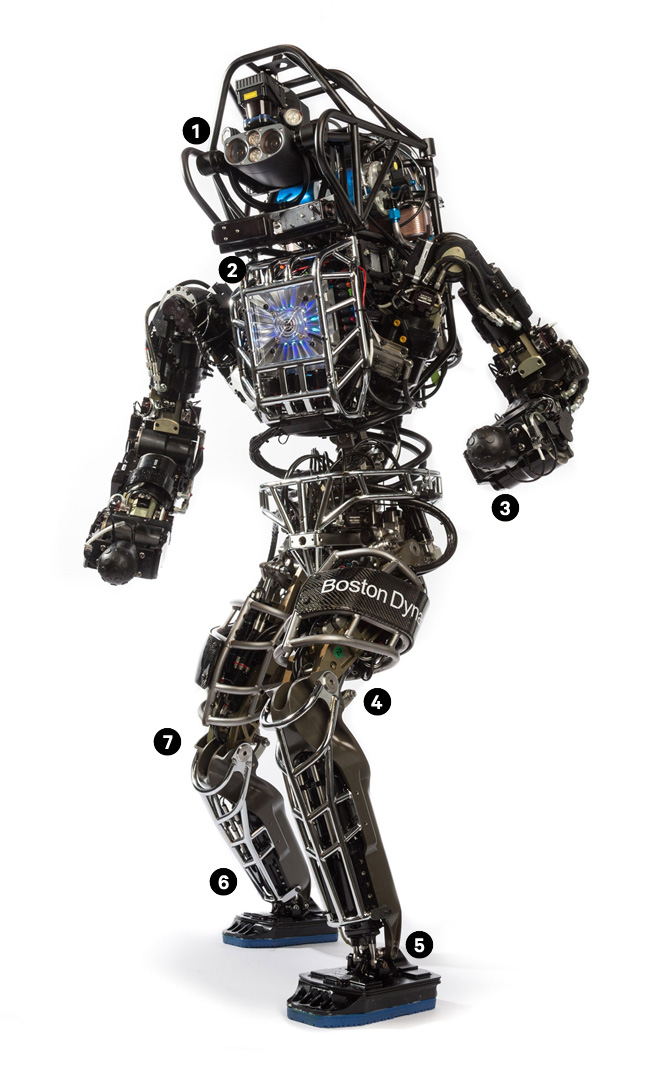
This 6-Foot, 330-Pound Robot May One Day Save Your Life


Wired - Meet Atlas, the Pentagon’s 6'2", 330-pound humanitarian robot. He was designed to save lives in disaster zones (like Fukushima). But while this Tin Man has a heart, he lacks a brain. In December, seven teams of scientists from top institutions, including MIT and Virginia Tech, will compete to code the bot for action. Each team will send its own Atlas into Darpa’s trials—eight tasks that will test his ability to navigate degraded terrain, drive a utility vehicle, and enter buildings. “We designed Atlas to facilitate programming, but we expect Darpa to make the com­petition challenging,” says Marc Raibert, president of Boston Dynamics, Atlas’ maker. Here’s the skinny on the massive bot.

Read More

Tuesday, April 17, 2012

Video: Mood-Sensing Robot Prison Guard Begins First Real-World Test in Korea


Robotic Prison Guard – Reuters

Back in November, South Korea announced that a project to create robot prison guards was underway. And just as predicted, the robo-guards are ready for their first tests. Check out video (complete with prisoner/robot interaction) after the jump.     More


Tuesday, April 3, 2012

Lamprey Micro-Robot Could Detect Disease


Discovery News - To locate disease in the human body, it would be great if a doctor could get inside and look around. Imaging technology helps, but the resolution of the image isn’t always good enough for analysis. On top of that shortcoming, a lot of imaging technologies, like MRIs, involve using large, expensive machines the size of a small room.

That’s where something called cyberplasm comes in. To learn more about this micro-robot, which fuses together microelectronics and biomimicry, Daniel Frankel of Newcastle University is leading a U.K.-based study with the support of a research team from the National Science Foundation in the United States.

BLOG: Flying Robot Swarm Performs James Bond Theme
The idea is to have an electronic nervous system (which every robot ultimately has) with sight and smell sensors derived from animal cells. Cyberplasm’s artificial muscles would be powered by glucose, just as real muscles are. In addition, the robot would respond to light and chemical stimuli the same way a real creature does.                More

Wednesday, March 21, 2012

Video: DARPA’s Cheetah Sets a Land-Speed Record for Running Robots


PopSci - About a year ago we got our first look at DARPA’s Cheetah ‘bot via a concept drawing that looked more like a storyboard frame for a Transformers film than real, live robotics. Today, we get to see much more than a concept. In a video released by DARPA, the Boston Dynamics-built Cheetah hits the treadmill, notching what DARPA says is a new land speed record for legged robots at 18 miles per hour.                More

Sunday, March 11, 2012

Microsoft releases Robotics Developer Studio 4, bring your own Kinect


It’s been available in beta for a few months, but Microsoft has now made the final version of its Robotics Developer Studio 4 toolkit available for download.       More

Friday, March 9, 2012

Navy’s Newest Robot Is A Mechanized Fireman


Danger Room - Add another eerily life-like robot to the military’s rapidly expanding android army. This one is, of all things, a mechanical firefighter. And not only can it climb ladders like its flesh-and-blood counterparts, it’s designed to interact with human handlers in a kind of human/robot bucket brigade.

Developed by the Naval Research Laboratory, the Shipboard Autonomous Firefighting Robot — or “SAFFiR”; get it? — will help extinguish fires onboard ships and subs. Those watercraft are particularly at risk from fires, because their cramped quarters can make flames tough to extinguish without posing significant human risk.

SAFFiR, expected to be field tested in 18 months, might mitigate that danger. And it shows off some of the the latest and most impressive breakthroughs in Pentagon-funded robotics technology.

For one thing, SAFFiR is designed to use its mechanized legs and arms like a human would, thanks to sophisticated sensors that provide ongoing environmental feedback and titanium springs that act as “joints” to enable fluid movements. Until recently, most military robots designed for cramped spaces like the quarters of warships or submarines needed to be small. Wheels and treads enabled movement, not pseudo-limbs. (Well, mostly.)

Now, much like a person, SAFFiR will scurry through cramped hallways and climb up and down the endless maze of ladders aboard a ship. The robot will have enough hand coordination to tote fire hoses and throw extinguisher grenades. That kind of precise coordination is also a relatively new accomplishment for military ‘bots. Just last week, Darpa-funded researchers unveiled the first ‘bot capable of performing complex tasks, like unlocking a door, with its own “two hands.”           More

Wednesday, October 12, 2011

'Thinking' Robot Teaches Itself a Task


This robot is not pre-programmed, but instead problem-solves based on knowledge and experience. Click to enlarge this image. Youtube Screengrab

Instead of performing tasks based on a computer program, this robot problem solves on the fly.


THE GIST
  • A Japanese researcher has developed a system that allows a robot to solve problems.
  • With the algorithm, the robot uses its knowledge to complete tasks it has been asked to do.
Robots that learn from experience and can solve novel problems — just like humans — sound like science fiction.

But a Japanese researcher is working on making them science fact, with machines that can teach themselves to perform tasks they have not been programmed to do, using objects they have never seen before.

In a world first, Osamu Hasegawa, associate professor at the Tokyo Institute of Technology, has developed a system that allows robots to look around their environment and do research on the Internet, enabling them to “think” how best to solve a problem.

BLOG: Bi-Ped Robot Has Heel-to-Toe Walking

“Most existing robots are good at processing and performing the tasks they are pre-programmed to do, but they know little about the ‘real world’ where we humans live,” he told AFP. “So our project is an attempt to build a bridge between robots and that real world.
The Self-Organizing Incremental Neural Network, or “SOINN,” is an algorithm that allows robots to use their knowledge — what they already know — to infer how to complete tasks they have been told to do.

SOINN examines the environment to gather the data it needs to organize the information it has been given into a coherent set of instructions.

robotic hand

DNEWS VIDEO: MIND-CONTROLLED ROBOTS, CYBORGS AND ROBOTIC CARS


Tell a SOINN-powered machine that it should, for example: “Serve water.”
Without special programs for water-serving, the robot works out the order of the actions required to complete the task.

The SOINN machine asks for help when facing a task beyond its ability and crucially, stores the information it learns for use in a future task.

In a separate experiment, SOINN is used to power machines to search the Internet for information on what something looks like, or what a particular word might mean.
Hasegawa’s team is trying to merge these abilities and create a machine that can work out how to perform a given task through online research.           More
Friday, September 16, 2011

Robot Caddy Follows Golfers


Caddy Trek: $1,200 (anticipated)


Discovery News - If you’re thinking of becoming a pro-golfer, avoid the eventual hurt feelings that will happen whenever you decide to let go of your caddy (lest you go through the other painful breakup Tiger Woods experienced recently) by picking up a silent, robot caddy. The Caddy Trek is a compact foldable cart that follows you at walking speed on the course, and stops when you stop. It premiered last month at 2011 PGA Expo in Las Vegas, Nevada.              More